The AA-type banknotes, manufactured by the American Bank Note Company, were put into circulation by Banco de Mexico as follows: the first issue between 1925 and 1934, the second issue between 1936 and 1942, and the third between 1936 and 1978.
They were withdrawn from circulation as from 1992. They are currently demonetized because they belong to the monetary unit that remained valid until December 31, 1992. This means that they are no longer legal tender and cannot be used for transactions. Their current value is equivalent to one thousandth of their original value.
First issuance
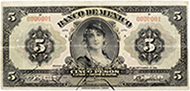
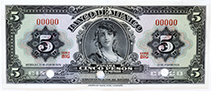
Characteristics of the five peso banknote from the first series.
| Obverse |
The banknote front features an image of an Algerian young woman, popularly known as "the gipsy."
All rights reserved © |
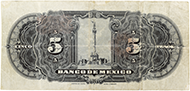
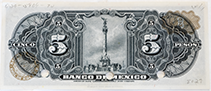
| Reverse |
On the back, the Column of Independence, popularly known as the "Angel of Independence", in Mexico City.
All rights reserved © |
| Years of issuance | 1925, 1931-1934 |
| Size (mm) | 180 x 83 |
| Material | Cotton paper |
| Denomination | 5 pesos |
| Current value | 0.005 pesos |
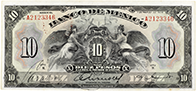
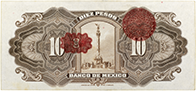
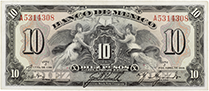
Characteristics of the ten peso banknote of the first series
| Obverse |
Allegory of two winged nymphs holding an open book, symbolizing "The Law".
All rights reserved © |
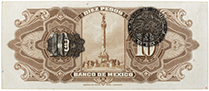
| Reverse |
On the back, the Column of Independence, popularly known as the "Angel of Independece", in Mexico City.
All rights reserved © |
| Years of issuance | 1925, 1931-1934 |
| Size (mm) | 180 x 83 |
| Material | Cotton paper |
| Denomination | 10 pesos |
| Current value | 0.01 pesos |
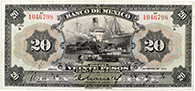
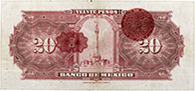
Characteristics of the twenty peso banknote of the first series
| Obverse |
Port scene featuring different means of transport.
All rights reserved © |
| Reverse |
On the back, the Column of Independence, popularly known as the "Angel of Independece", in Mexico City.
All rights reserved © |
| Years of issuance | 1925, 1931-1934 |
| Size (mm) | 180 x 83 |
| Material | Cotton paper |
| Denomination | 20 pesos |
| Current value | 0.02 pesos |
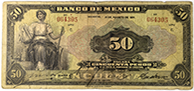
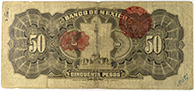
Characteristics of the fifty peso banknote of the first series
| Obverse |
Alleory of navigation.
All rights reserved © |
| Reverse |
On the back, the Column of Independence, popularly known as the "Angel of Independece", in Mexico City.
All rights reserved © |
| Years of issuance | 1925, 1931-1934 |
| Size (mm) | 180 x 83 |
| Material | Cotton paper |
| Denomination | 50 pesos |
| Current value | 0.05 pesos |
Characteristics of the one hundred peso banknote of the first series
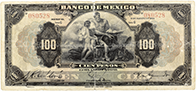
| Obverse |
Allegory of maritime trade.
All rights reserved © |
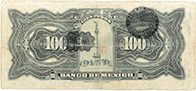
| Reverse |
On the back, the Column of Independence, popularly known as the "Angel of Independece", in Mexico City.
All rights reserved © |
| Years of issuance | 1925, 1931-1934 |
| Size (mm) | 180 x 83 |
| Material | Cotton paper |
| Denomination | 100 pesos |
| Current value | 0.10 pesos |
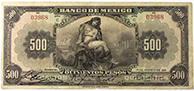
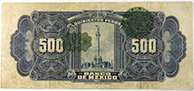
Characteristics of the five hundred peso banknote of the first series
| Obverse |
Allegory of electrical energy.
All rights reserved © |
| Reverse |
On the back, the Column of Independence, popularly known as the "Angel of Independece", in Mexico City.
All rights reserved © |
| Years of issuance | 1925, 1931-1934 |
| Size (mm) | 180 x 83 |
| Material | Cotton paper |
| Denomination | 500 pesos |
| Current value | 0.50 pesos |
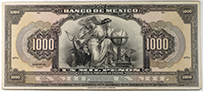
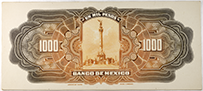
Characteristics of the one thousand peso banknote of the first series
| Obverse |
Allegorical figure Tyche, the Greek goddess of fate.
All rights reserved © |
| Reverse |
On the back, the Column of Independence, popularly known as the "Angel of Independece", in Mexico City.
All rights reserved © |
| Years of issuance | 1925, 1931-1934 |
| Size (mm) | 180 x 83 |
| Material | Cotton paper |
| Denomination | 1,000 pesos |
| Current value | 1 peso |
Second issuance
Characteristics of the five peso banknote of the second series
| Obverse |
The banknote front features an image of an Algerian young woman, popularly known as "the gipsy."
All rights reserved © |
| Reverse |
On the back, the Column of Independence, popularly known as the "Angel of Independece", in Mexico City.
All rights reserved © |
| Years of issuance | 1936 |
| Size (mm) | 157 x 67 |
| Material | Cotton paper |
| Denomination | 5 pesos |
| Current value | 0.005 pesos |
Characteristics of the ten peso banknote of the second series
| Obverse |
Allegory of two winged nymphs holding an open book, symbolizing "The Law".
All rights reserved © |
| Reverse |
On the back, the Column of Independence, popularly known as the "Angel of Independece", in Mexico City.
All rights reserved © |
| Years of issuance | 1936 |
| Size (mm) | 157 x 67 |
| Material | Cotton paper |
| Denomination | 10 pesos |
| Current value | 0.01 pesos |
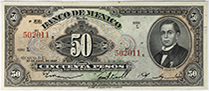
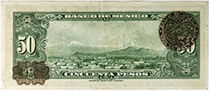
Characteristics of the fifty peso banknote of the second series
| Obverse |
Portrait of Ignacio Zaragoza.
All rights reserved © |
| Reverse |
Panoramic view featuring the Iztaccihuatl and Popocatépetl volcanoes.
All rights reserved © |
| Years of issuance | 1937, 1940 |
| Size (mm) | 157 x 67 |
| Material | Cotton paper |
| Denomination | 50 pesos |
| Current value | 0.05 pesos |
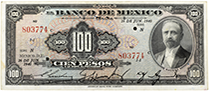
Characteristics of the one hundred peso banknote of the second series
| Obverse |
Portrait of Francisco I. Madero.
All rights reserved © |
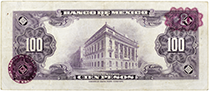
| Reverse |
View of Banco de México's main building.
All rights reserved © |
| Years of issuance | 1936, 1940-1942 |
| Size (mm) | 157 x 67 |
| Material | Cotton paper |
| Denomination | 100 pesos |
| Current value | 0.10 pesos |