Distributors
This fine collection of coins represents about five centuries of the numismatic heritage of Mexico. In the collection you can find the famous first pieces minted in Mexico during the sixteenth century or the beautiful Mexican coins of the twentieth century. The mere contemplation of the coins in this collection may be compared to a journey through the most intense episodes in the history of Mexico, while allowing an overview of Mexican art. Of course, it is also a precious treasure for numismatic experts.
At the center, a sculptural relief of the National Shield encompassed by the legend “Estados Unidos Mexicanos”. Smooth rim.

Case with Series IV coins

Common obverse
At the center, the reverse of a 1 peso Villa revolutionary coin, 1914, minted in Cuencamé, Durango, six stars; at the upper side, parallel to the coin frame, the legend “HERENCIA NUMISMÁTICA DE MÉXICO” (NUMISMATIC HERITAGE OF MEXICO); on the left side, the Mexican mint mark, while on the right field is the “$” sign followed by the number “100”, dotted edging. The frame is flat.

Reverse
Villa revolutionary coin “Muera Huerta” (1 peso, 1914, Cuencamé, Durango, six stars, silver)
To alleviate the scarcity of money and help pay for the expenses originated by the Revolution, Francisco Villa ordered generals Calixto Contreras and Severino Ceniceros the minting of coins. One-peso pieces, of which many varieties are known, were cast in Cuencamé. This coin has the republican rays, surrounded by the inscription ESTADOS UNIDOS MEXICANOS (United Mexican States) and, in the exergue, the denomination and the mint year with six stars aside, the rarest variety in its type. On the front, there is the legend MUERA HUERTA (May Huerta Die), an expression of the Northern Revolutionaries hatred against Victoriano Huerta.

Reverse |

Obverse |
At the center, the obverse of a Ferdinand VI milled colonial coin, 8 escudos, 1748, “pelucona” type, gold, minted in Mexico; at the upper side, parallel to the coin frame, the legend “HERENCIA NUMISMÁTICA DE MÉXICO” (NUMISMATIC HERITAGE OF MEXICO); on the left side, the Mexican mint mark, while on the right field is the “$” sign followed by the number “100”, dotted edging. The frame is flat.

Reverse
Ferdinand VI colonial coin (8 escudos, 1748, M° mint mark, assayer’s initial M, “pelucona”, second type, gold)
The gold colonial coins minted under the name of Phillip V and Ferdinand VI are known as “peluconas” due to the large characteristic wigs wore by both monarchs. In this case, it is an aureus 8-escudo piece minted under Ferdinand VI name, and on its obverse there is the figure of the king dressed with a suit of armor and a tunic, the inscription FERDND VI D G HISPAN ET IND REX (Ferdinand VI in the grace of God, King of Spain and the Indies) and, in the exergue, the mint year. This type of coin was struck from 1748 to 1751.

Reverse |

Obverse |
At the center, the obverse of a Free and Sovereign State of Oaxaca revolutionary coin, 60 pesos, 1916, minted in Oaxaca; at the upper side, parallel to the coin frame, the legend “HERENCIA NUMISMÁTICA DE MÉXICO” (NUMISMATIC HERITAGE OF MEXICO); on the left side, the Mexican mint mark, while on the right field is the “$” sign followed by the number “100”, dotted edging. The frame is flat.

Reverse
Free and Sovereign State of Oaxaca revolutionary coin (60 pesos, 1916, Oaxaca, gold)
In June 1915, the state of Oaxaca reassumed its sovereignty due to the political instability prevailing in the country at the time. It was then that the governor José Inés Dávila ordered the minting of its own coins. The typical piece of this issuance was the 60-peso gold coin, which on its obverse depicts the portrait of Benito Juárez, surrounded by a wreath and by the inscription ESTADO L. Y S. DE OAXACA (F. and S. State of Oaxaca). In addition to this piece, 1-, 2-, 5-, 10-, and 20-peso coins as well as 1-, 3-, 5-, 10-, 20-, and 50-cent coins were produced. The metals used were gold, silver, and copper.

Reverse |

Obverse |
At the center, the reverse of a royalist provisional coin from Oaxaca, 8 reales, 1812, big lion; at the upper side, parallel to the coin frame, the legend “HERENCIA NUMISMÁTICA DE MÉXICO” (NUMISMATIC HERITAGE OF MEXICO); on the left side, the Mexican mint mark, while on the right field is the “$” sign followed by the number “100”, dotted edging. The frame is flat.
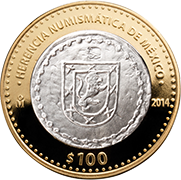
Reverse
Royalist provisional coin (8 reales, 1812, Oaxaca, “león grande” big lion, silver)
During the War of Independence, the scarcity of coins was one of many problems the authorities in New Spain had to face. To resolve it, royalist general Antonio González Sarabia ordered the minting of coins in Oaxaca. One of those coins was this piece, which on its reverse has eight cross-shaped spades or San Andrés-type spades and, at the center, a fierce lion staring to the right. On the same year, 8-, 1-, and ½-real coins were minted in silver.

Reverse |

Obverse |
At the center, the obverse of a Charles IV counterstamped colonial coin, 8 reales, 1806, bust type, minted in Mexico, with British Guiana countermark.; at the upper side, parallel to the coin frame, the legend “HERENCIA NUMISMÁTICA DE MÉXICO” (NUMISMATIC HERITAGE OF MEXICO); on the left side, the Mexican mint mark, while on the right field is the “$” sign followed by the number “100”, dotted edging. The frame is flat.

Reverse
Charles IV colonial coin (8 reales, 1806, British Guiana counterstamped, silver)
During the XVIII and XIX centuries, the colonies in the Caribbean used foreign coins to satisfy their money needs. One of the pieces that had wider acceptance was the Mexican one, which was validated with counter-stamps by the colonial authorities. This piece has the British Guiana counter-stamp, which consists of a punched hole or stamp with the new value of three guilders (3G.L). The center was extracted from the coin to obtain another one of smaller denomination (3 bits).

Reverse |

Obverse |
At the center, the reverse of a Republican ¼ real coin, copper, 1834, letter A.; at the upper side, parallel to the coin frame, the legend “HERENCIA NUMISMÁTICA DE MÉXICO” (NUMISMATIC HERITAGE OF MEXICO); on the left side, the Mexican mint mark, while on the right field is the “$” sign followed by the number “100”, dotted edging. The frame is flat.

Reverse
Republican coin (1/4 real, 1834, M° mint mark, assayer’s initial A, copper)
The lack of coins was a recurrent problem for the working classes during the first post-Independence decades in Mexico. The minting of copper quarter-real coins contributed to solve this situation. However, since they were frequently counterfeited and minted with no restrictions, they had a depreciated value and this brought new economic problems to the country. The reverse of this piece has the ¼-real denomination on the center, surrounded by a two-palm neat line. Underneath and in a semicircle, the M° mint mark, the essayer’s initial A, and the mint year.

Reverse |

Obverse |
| Year of mintage | 2014 |
| Face value | 100 pesos |
| Diameter | 39.0 mm |
| Edge | Interrupted milled |
| Quality | Proof-like |
| Composition | Bimetallic
|
| Total weight | 33.967 grams |